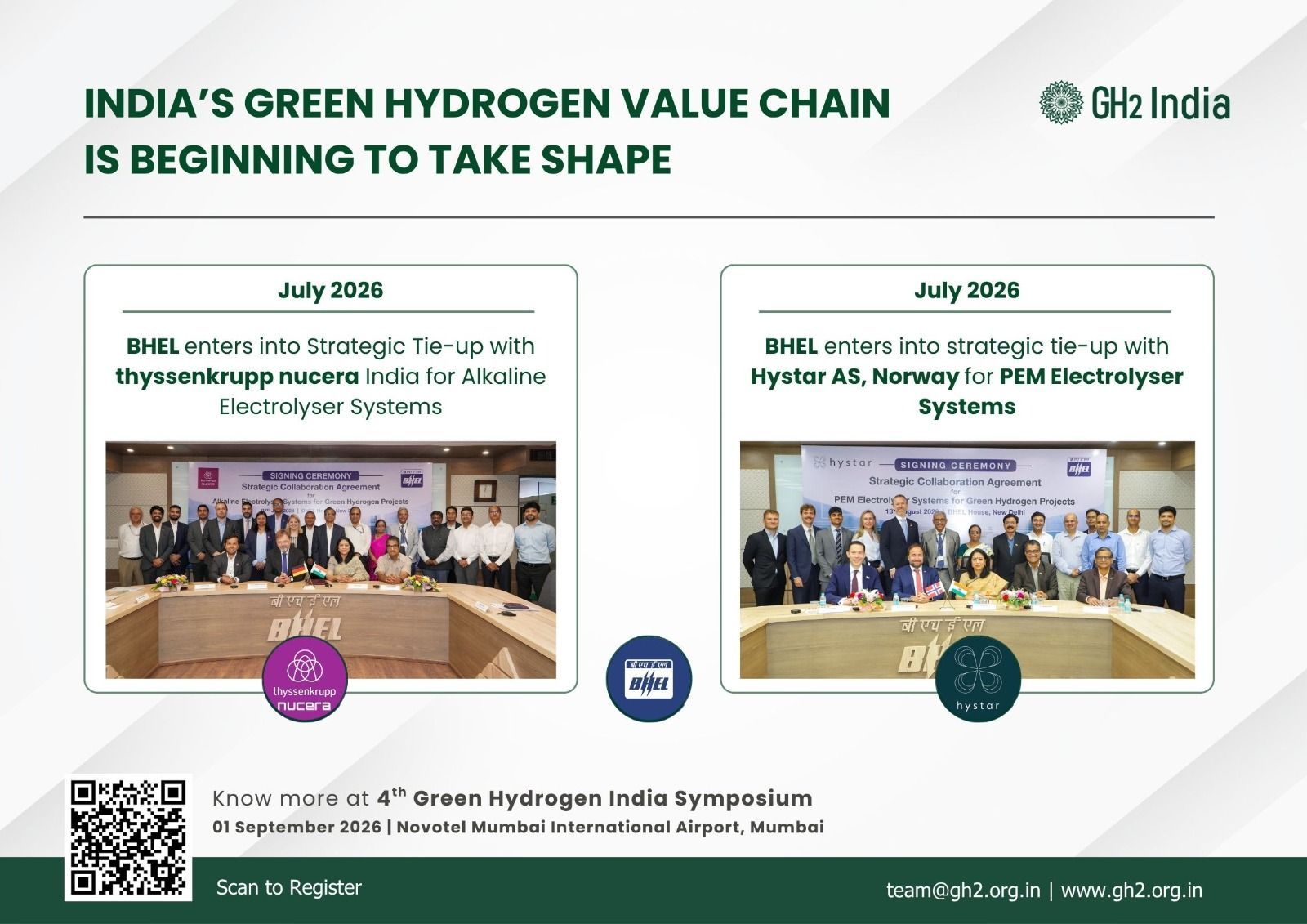
Bharat Heavy Electricals Limited (BHEL) has entered into a strategic tie-up with Norwegian electrolyser company Hystar AS for PEM electrolyser systems, adding another technology route to its growing green hydrogen business.
The agreement will enable phased indigenisation and local manufacturing of Hystar’s PEM electrolyser systems for green hydrogen projects in India. It comes shortly after BHEL entered into a separate partnership with thyssenkrupp nucera India for alkaline electrolyser systems.
With these partnerships, BHEL is positioning itself to offer both PEM and alkaline electrolyser systems.
WHY THIS MATTERS?
There is no single electrolyser technology that fits every green hydrogen project.
Alkaline electrolysers are a mature technology widely considered for large-scale hydrogen production. PEM electrolysers can respond quickly to changes in electricity supply, making them particularly relevant when hydrogen production is connected with variable renewable power.
BHEL’s partnership with thyssenkrupp nucera India provides a route to phased indigenisation and local manufacturing of alkaline systems, while the Hystar partnership extends that strategy to PEM technology.
Technology requirements vary depending on renewable power availability, operating profile, project size, hydrogen end use and economics. Having access to both technologies could allow BHEL to participate across a wider range of green hydrogen projects.
WHAT IT REFLECTS ABOUT INDIA’S GREEN HYDROGEN MARKET?
India’s green hydrogen conversation is increasingly turning towards the equipment, manufacturing capacity and supply chains required to convert announced projects into operating assets.
Electrolysers are a key part of this system. India’s green hydrogen ambitions will require significant electrolyser capacity, while developing a domestic hydrogen industry also means reducing dependence on imported equipment and technology over time.
BHEL’s approach is therefore notable. Rather than building its green hydrogen equipment business around a single technology partnership, the company is gaining access to different electrolyser technologies while leveraging its existing manufacturing and project execution capabilities.
The phased indigenisation element is equally important. If localisation progresses as planned, the opportunity is not only to assemble electrolyser systems in India but gradually develop more of the manufacturing and supply chain domestically.
This aligns with the National Green Hydrogen Mission and the government’s wider Make in India push.
WHY PEM ADDS ANOTHER PIECE TO BHEL’S STRATEGY
The Hystar agreement gives BHEL a route into PEM electrolysers alongside its alkaline partnership, creating a broader technology portfolio at a time when the Indian market has yet to settle around one dominant electrolyser technology.
Different projects may make different technology choices. A large industrial hydrogen facility with relatively stable power supply may prioritise one set of operating and cost characteristics, while a project built around fluctuating solar and wind generation may place greater value on operational flexibility.
Offering both technologies could allow BHEL to match electrolyser systems more closely with individual project requirements.
The partnership could also strengthen BHEL’s role beyond equipment manufacturing. Combined with its engineering, manufacturing and project execution experience, this could create opportunities to participate across a larger part of the green hydrogen project value chain.
THE CHALLENGES AHEAD
The partnerships are an important step, but execution will be critical.
Phased indigenisation requires localisation of components, supplier development, manufacturing scale, quality control and sufficient project demand.
Cost will matter too. India’s green hydrogen market is highly price-sensitive, and local manufacturing will ultimately need to translate into commercially competitive equipment.
India has announced a large pipeline of green hydrogen and derivative projects, but many still need renewable power, financing, infrastructure and long-term offtake before reaching construction.
The bigger question is how quickly technology partnerships translate into local manufacturing, competitive equipment and operating green hydrogen projects.
As India’s hydrogen market develops, technology tie-ups will matter. But localisation, cost and execution will determine which companies ultimately build a meaningful position in the market.