India's Green Hydrogen Story Enters Its Commercial Phase
For much of the past three years, the global green hydrogen sector has been defined by ambition rather than execution. Projects were announced, policies introduced, and investment pipelines expanded, but binding demand remained limited. Developers struggled to secure long-term offtake, while lenders and investors waited for commercially viable projects.
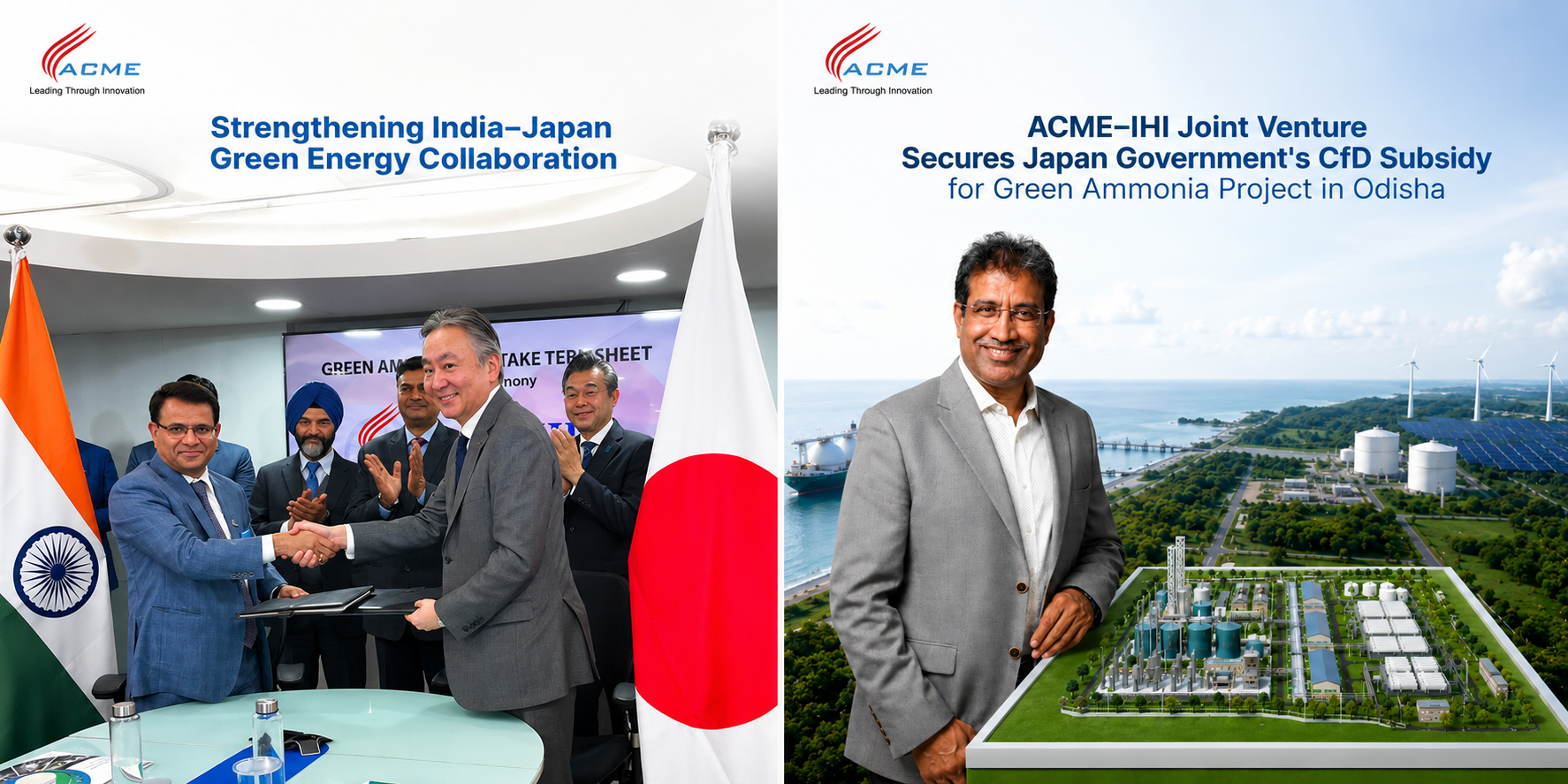
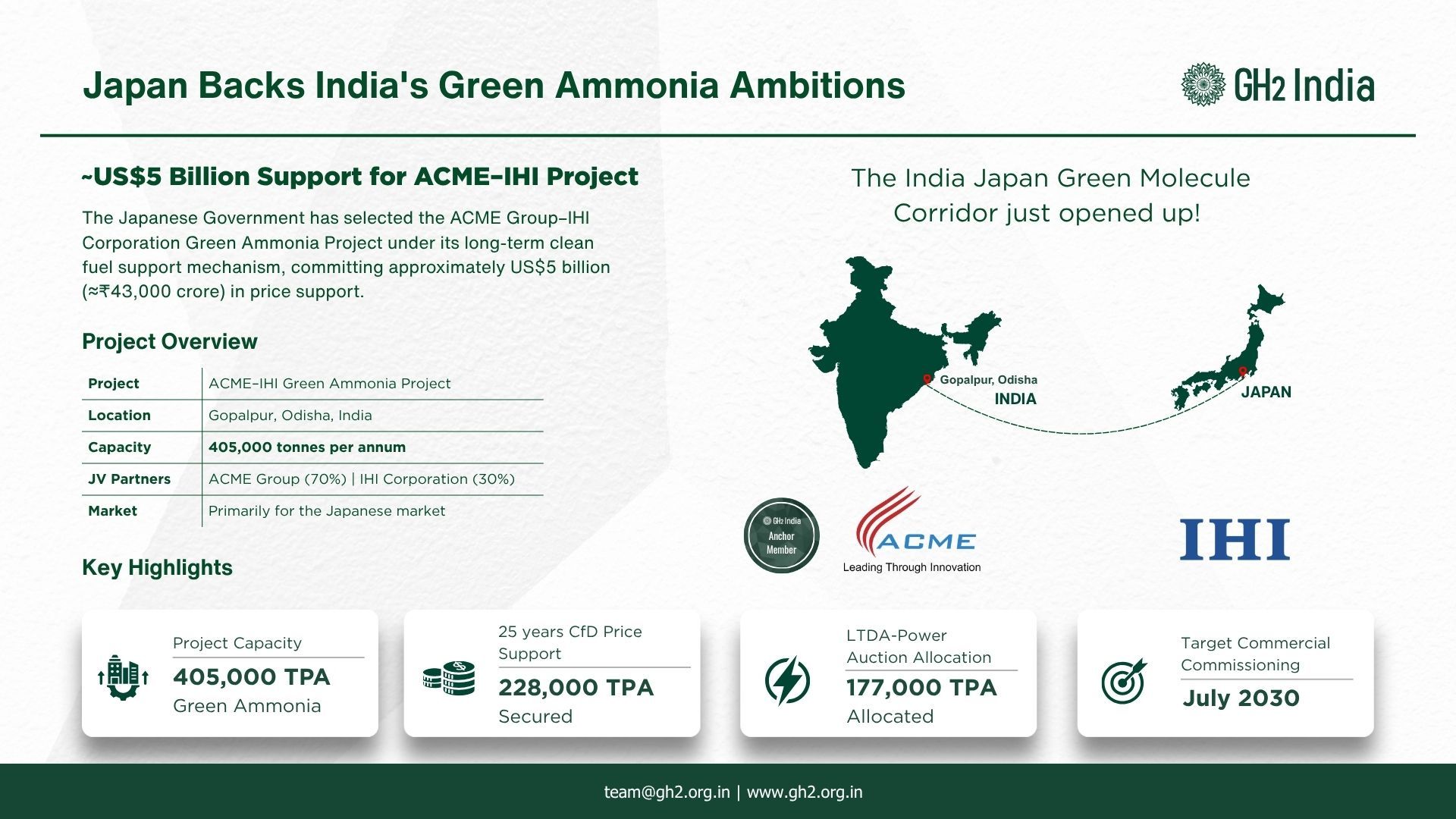
Recent milestones achieved by ACME Group indicate that this phase is changing. The company has secured long-term international demand for 488,000 TPA of renewable ammonia linked to its Odisha projects. The Gopalpur project, developed with IHI Corporation, has received support under Japan's Contract for Difference (CfD) framework and the Long-Term Decarbonized Power Source Auction, reinforcing Japan's role as an early market builder for clean hydrogen derivatives.
Domestically, ACME has signed a 10-year Green Ammonia Purchase Agreement with SECI for 370,000 TPA, creating one of India's strongest demand signals for fertiliser decarbonisation. Together, ACME's India-linked renewable ammonia portfolio now represents approximately 858,000 TPA.
International expansion is equally significant. ACME's Duqm project in Oman has secured a long-term offtake agreement with Yara for 100,000 TPA of renewable ammonia from 2027 onwards. The company is also developing a 200,000 TPA renewable methanol project in Kendrapada, Odisha, with 100,000 TPA expected to be supplied to Mitsubishi Gas Chemical Europe GmbH, strengthening India's position in sustainable shipping fuels and green chemicals.
These developments highlight an important shift. The first globally traded clean hydrogen markets are expected to emerge through hydrogen derivatives such as ammonia and methanol, which can be transported using existing global infrastructure. India's renewable resource base positions it well to become a competitive exporter of these clean molecules.
Japan and Europe are simultaneously creating long-term demand. Japan is supporting clean hydrogen imports through policy-backed mechanisms that provide price certainty, while Europe is creating compliance-driven demand through regulations including RFNBO, FuelEU Maritime, and the EU Emissions Trading System. These frameworks are encouraging long-term supply partnerships with globally competitive producers.
India's commercial offtake base is now becoming tangible. In addition to ACME's agreements, AM Green has signed an agreement with Uniper, L&T Energy GreenTech has partnered with ITOCHU Corporation, Reliance Industries has entered a long-term agreement with Samsung C&T, and SECI's Mode-2A programme has established 724,000 TPA of domestic fertiliser-linked demand. Refinery projects led by NeuEN Green Energy and L&T Energy GreenTech further demonstrate growing industrial adoption.
Operational deployment is also accelerating. India now hosts 44+ operational green hydrogen pilot projects, representing more than 64 MW of electrolyser capacity and over 9,000 TPA of production across mobility, refineries, steel, shipping, power, gas blending, and green fuels. These projects are generating valuable operational experience while strengthening investor confidence.
Odisha is emerging as one of India's most promising clean molecule hubs, supported by strategic port infrastructure, renewable energy resources, industrial demand, and export connectivity. Projects across Gopalpur, Paradip, and Kendrapada demonstrate the state's growing role in renewable ammonia and renewable methanol production.
While challenges remain around infrastructure, certification, financing, and project execution, the sector is clearly transitioning from announcements to commercial deployment. India is no longer preparing for a future green hydrogen market—it is actively building one through long-term contracts, international partnerships, and industrial-scale investments that position the country as a key supplier in the emerging global clean fuels economy.